

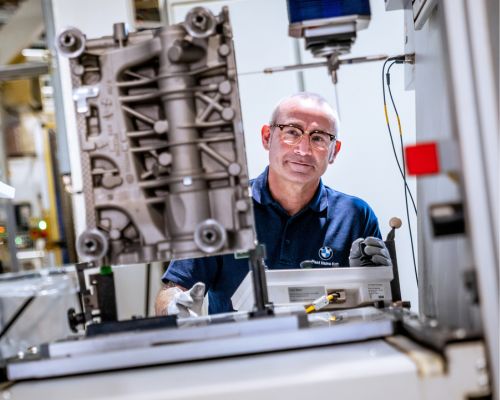

The BMW Group’s Hams Hall plant in the UK is celebrating a quarter-century of production, marking 25 years since its doors first opened in 2001. Located near Birmingham, the facility has become a global cornerstone for the brand, producing over 7.6 million highly efficient engines to date. Today, the plant serves as a vital hub for BMW, MINI, and Rolls-Royce, supplying precision-built power units for everything from compact three-cylinder models to high-performance V8 and bespoke V12 engines.
Efficiency is at the heart of Hams Hall’s legacy, with the plant achieving a 61% reduction in energy consumption per engine since its inception. This progress aligns with the BMW iFACTORY strategy, focusing on sustainable and digital manufacturing. Currently, the site operates using 100% renewable external electricity and has significantly cut its reliance on natural gas, proving that increased production volume can go hand-in-hand with a smaller environmental footprint.
Innovation at the plant is now led by “SpOTTO,” an autonomous four-legged robot dog developed by Boston Dynamics. Renamed in honor of BMW founder Gustav Otto, the robot uses thermal and acoustic sensors to monitor equipment and detect energy-wasting leaks. SpOTTO is a key contributor to the plant’s “digital twin”—a virtual 3D replica that allows engineers to simulate production processes in real-time, improving quality assurance and long-term planning.
The plant’s history is defined by its adaptability and technological “firsts.” In 2001, it pioneered the large-scale use of Valvetronic technology, and by 2013, it became the exclusive producer of the award-winning engines for the BMW i8. In 2022, Hams Hall expanded its prestige by taking over the assembly of V8 and V12 engines, including the handcrafted V12 units destined for Rolls-Royce Motor Cars in Goodwood.
As it enters its next chapter, Hams Hall remains a competitive and integral part of BMW’s global production network. Dirk Dreher, Head of Plant Hams Hall, credits the site’s success to the passion of its workforce and a commitment to continuous improvement. With a robust digital infrastructure and a diverse engine portfolio, the plant is well-positioned to drive the future of both traditional and hybrid powertrains for years to come.